
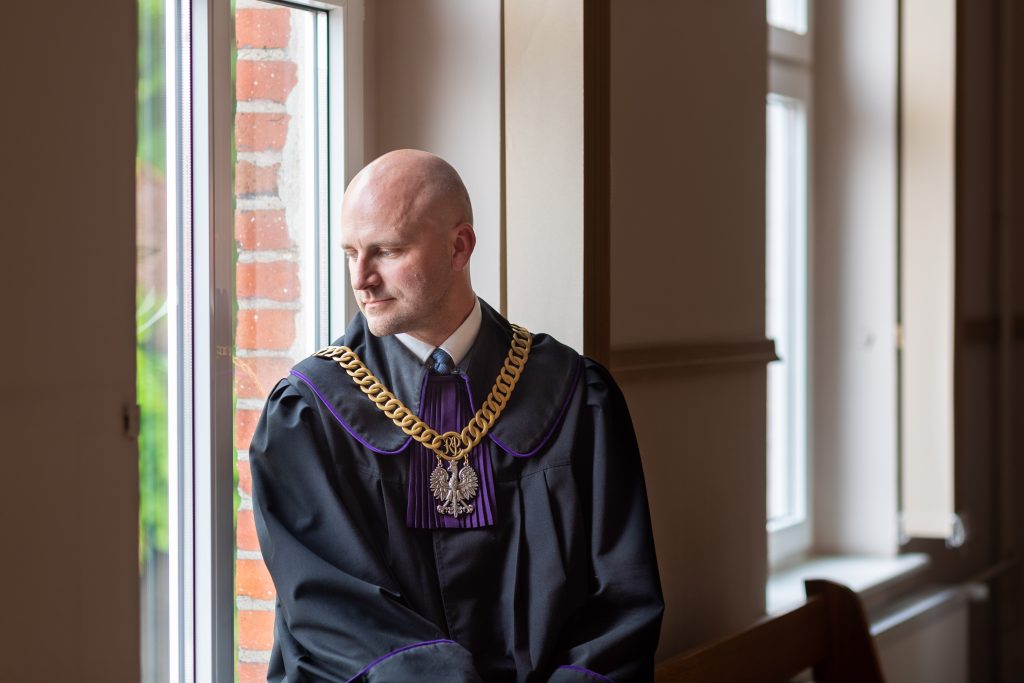
Bartłomiej Starosta
Judge since 2008, District Court in Sulęcin
For a long time the courts have been a whipping boy for politicians. This is why the present government has no intention of repairing the justice system. The smooth functioning of the judiciary would divert attention away from the courts and towards the executive, exposing it to criticism in the process.
•••
Judges saw a need for making changes in the way the courts functioned but our proposals were ignored. For example, one could pinpoint the draft law on the National Council of the Judiciary, which aimed at eliminating irregularities in the process of appointing members of the body tasked with upholding the independence of the courts and the independence of judges, and to repair the procedure for appointing judges. Citizens must be aware that as judges we have absolutely no interest in prolonging trials. None whatsoever. Every prolonged trial means more work. Each of us has to deal with up to several hundred cases at the same time (I currently have about 300). Most judges receive piles of letters every day. Each letter has to be read and the appropriate procedural decision taken. Therefore, it would be much better to handle cases more efficiently. In civil cases, a major stumbling block for the rapid conclusion of proceedings is the availability of expert witnesses. For years, this was not properly regulated. Current regulations and rates of remuneration mean that few specialists want to work with the courts. Furthermore, those who are registered expert witnesses often need months and months to draw up an opinion. If, for example, evidence is submitted in a case related to civil liability for damage to someone’s health from testimonies of three witnesses and making use also of the opinions of three expert witnesses that are doctors each with a different specialisation, the case could last at least a year, and if a supplementary opinion is necessary then even longer.
•••
In any system where there is a tripartite division of power, these powers clash. In particular, the executive and legislative branches of government want more power for themselves. If we have a government and a parliament from one political party then what else is left for them to gain complete control over everything? The courts. If a political party is in government, has a majority in parliament as well as a president, the only thing it fears is losing a lawsuit in court. For that to happen, you have to have an independent judge who will be guided only by the law and will decide the dispute impartially and not always in favour of the political power.
•••
Every citizen has the right to use the judicial procedure, be it civil or criminal. However, they must remember that they are not making use of the services sector; citizens are also obliged to observe the rules of a given procedure. If, for example, they fail to submit evidence on time, they may lose the trial regardless of who is right in the dispute. Politicians of the ruling party say that a judge plays a subservient role in relation to the state and the citizen, but that is not the case. Our job is to the judicial service and this does not mean that a judge’s role is to satisfy the claims of every citizen who comes to court. When you have two parties with conflicting interests, you cannot satisfy both. The person who wins a trial may also be dissatisfied. For example, he or she might not feel satisfied because in his or her opinion the trial took too long.
•••
There is no doubt that the rule of law and respect for various treaties are the basis for the existence of the European Union. If these treaties are not complied with, the membership of a state that does not act in accordance with the provisions of these treaties should be called into question. It may be difficult to explain to citizens how we can go ahead and violate these treaties, pay the fines for failure to respect the rule of law and at the same time belong to this Community. The EU cannot afford to have states such as Hungary or Poland failing to respect these treaties.
•••
In my opinion, once the rule of law has been restored in Poland, those who have betrayed the judicial oath (according to the Iustitia Polish Judges Association) should be subject to disciplinary proceedings. This should include a guarantee of the right to a court of law and to a defence counsel, similar to the proceedings applied to judges before the government’s ‘reform’.
•••
Recently, the Deputy Minister of Justice ‘delegated’ the head of our court to the Regional Court in Gorzów Wielkopolski. He was the only one in our group to support government-backed Jarosław Dudzicz by way of a letter to the new government-backed National Council of the Judiciary. What is more, as a result of this so-called “change for the good”, my already considerable workload has increased by more than 50%. In addition, four disciplinary proceedings have been initiated against me in connection with my activities over the past two years although I have not committed any disciplinary offence.