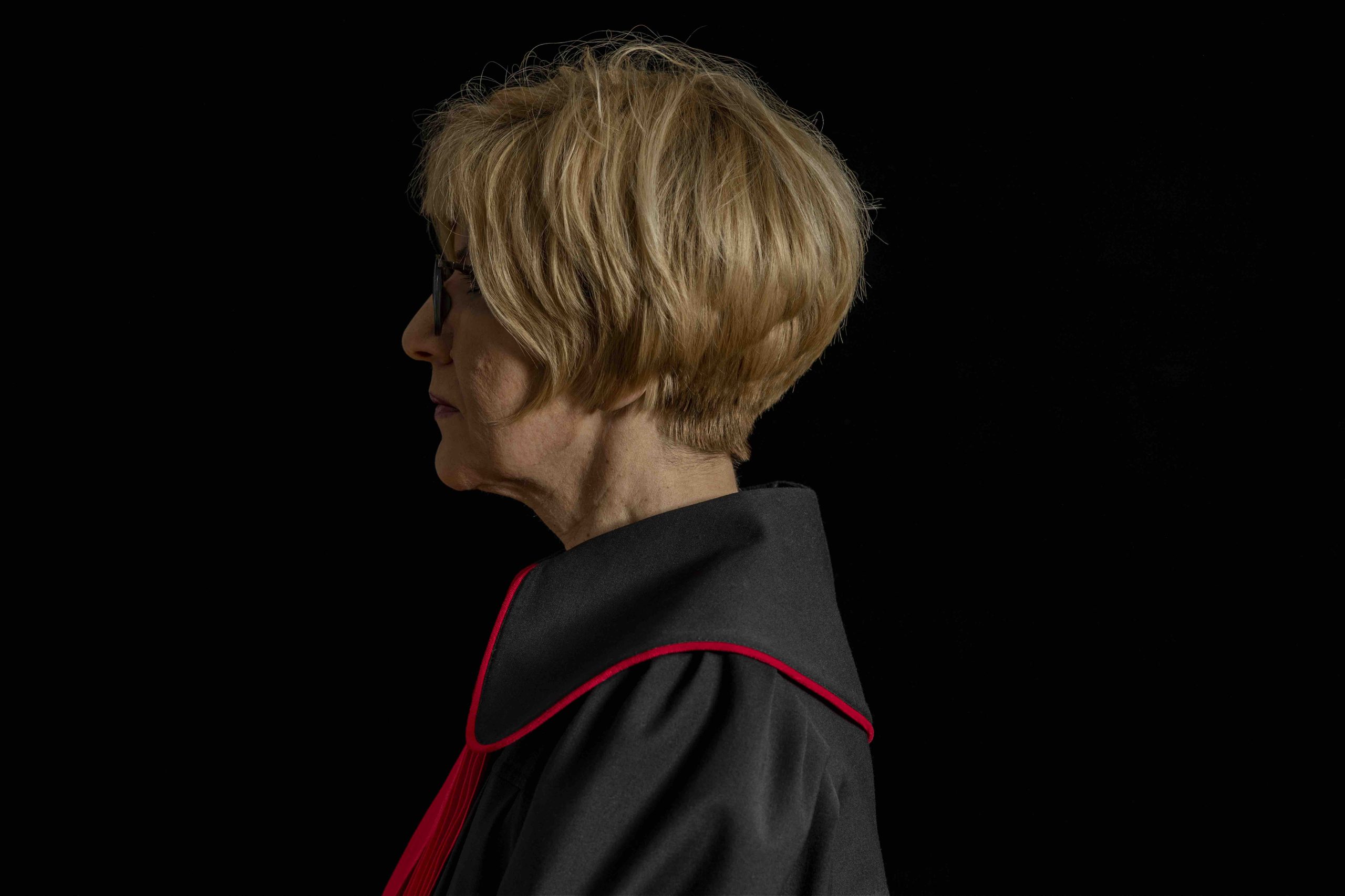
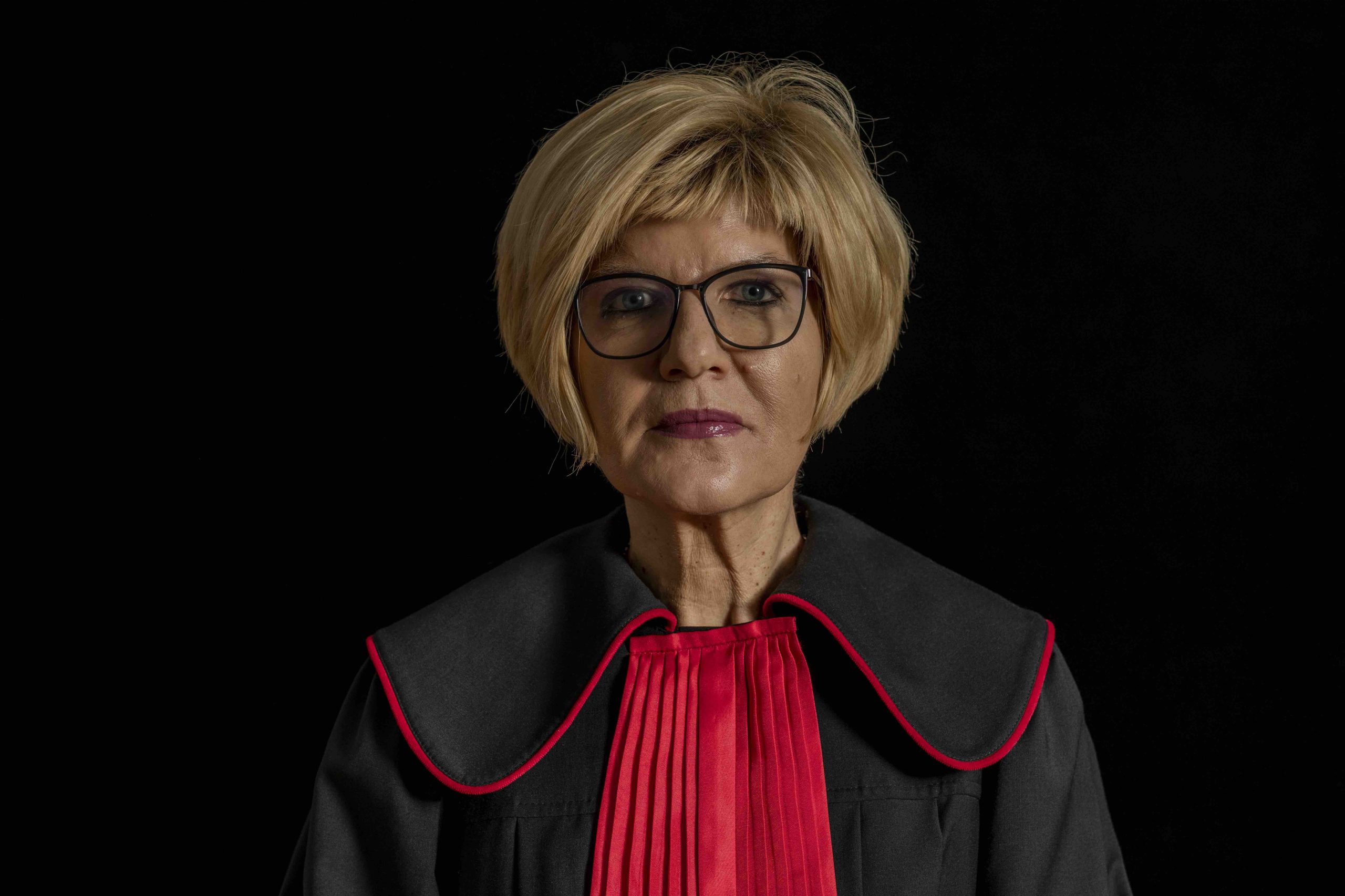
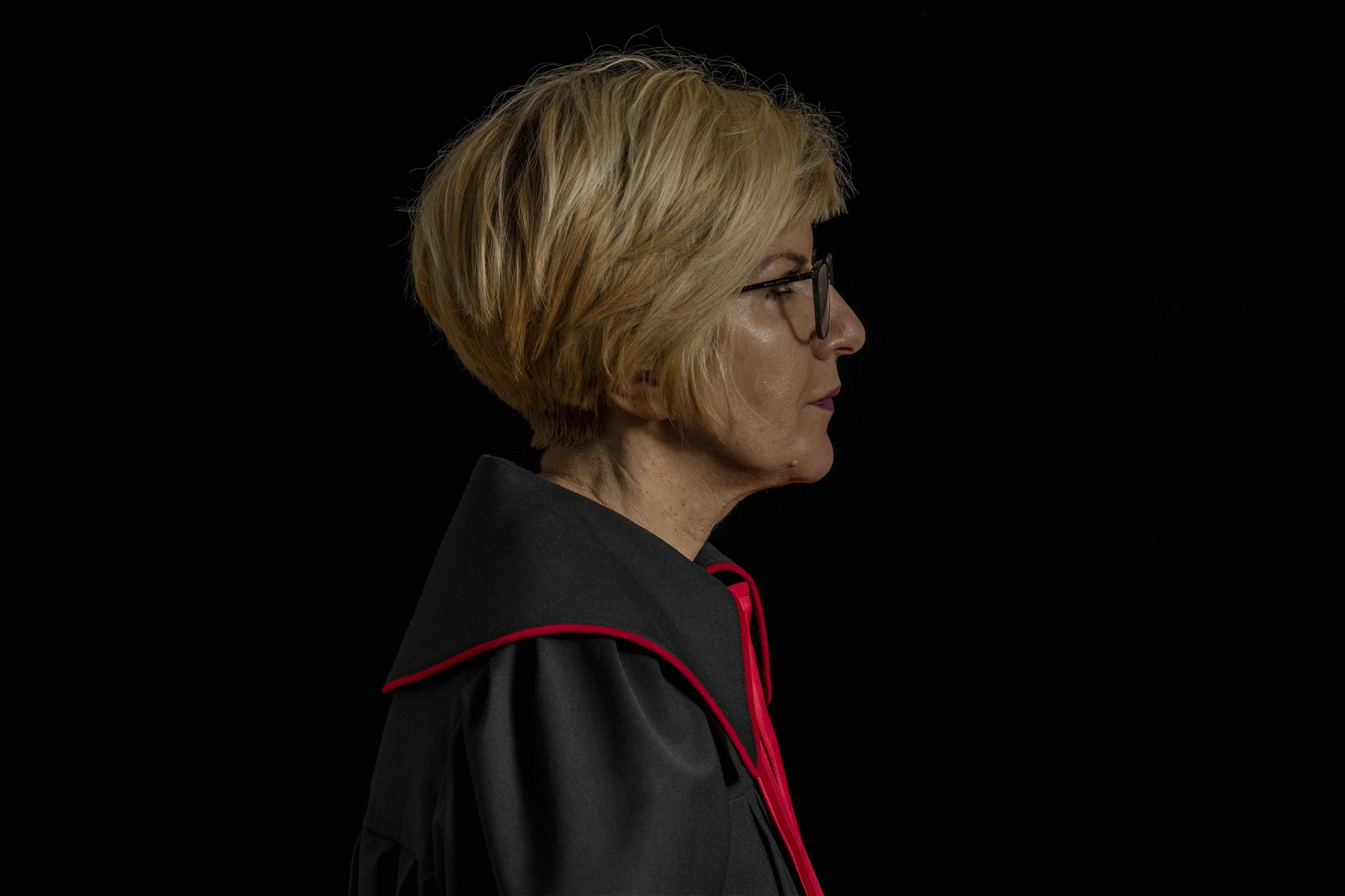
Katarzyna Kwiatkowska
Prosecutor since 1991, Regional Prosecutor’s Office of Warsaw-Praga, delegated out to the District Prosecutor’s Office in Golub-Dobrzyń (180 km away)
I worked as a prosecutor at the Appellate Public Prosecutor’s Office in Warsaw until 2016. I was then demoted to the Regional Prosecutor’s Office of Warsaw-Praga in Warsaw. On 18 January 2021, Deputy Prosecutor General Bogdan Święczkowski decided I was to be transferred to the District Prosecutor’s Office in Golub-Dobrzyń, the lowest possible official position.
•••
The public prosecutor’s office is a service; it acts on behalf of society and in the public interest in order to protect and respect civil rights and civil liberties. In all legal systems, prosecutors contribute to strengthening the guarantees of the rule of law, achieved in particular through the fair, impartial and effective administration of justice. The independence of the prosecution service is a necessary condition for judicial independence. Therefore, I cannot agree that serving in the prosecution service means serving the ruling party. We are supposed to uphold the rule of law, uphold the law, be guided by our knowledge and experience and not by the orders of our superiors or other people who want to violate our independence.
•••
By the third year of secondary school I was convinced I was going to study medicine. I wanted to become a paediatrician and wanted to help people but I was not very good at physics and I realised I would not do well in the exams. However, I was good at History and Polish. I got into law school and in the second year decided I would like to be a prosecutor because I have always been interested in prosecuting criminals and bringing them to justice. I also love the energy of the job.
•••
Transferring or ‘delegating out’ seven prosecutors to institutions far away from their home was intended to be a scare tactic. It provoked a discussion in our circles about the treatment of prosecutors. After the last ‘delegations’, our prosecutor’s association Lex Super Omnia received twelve declarations and clandestine discussions were ongoing. Would this provoke opposition from the leadership? In Poland, the Prosecutor General has both great administrative powers and great general powers. He can instruct prosecutors to undertake certain operations within a case, for example, to interrogate someone or other. He can overrule or change my decision, that is, he can directly interfere in the proceedings. What is more, he can forbid his orders being made available or visible to the parties in the case because such regulations were introduced into the Law on the Public Prosecutor’s Office. This means that the suspect, defence counsel, or victim will not know why a prosecutor acts in a particular way as dictated by his superior. In no other EU state is the Prosecutor General an active politician, the head of a ruling party and at the same time a member of parliament. What is more, he is a parliamentarian whose legal experience is generally inferior to all those prosecutors he is supervising. Even the Council of Europe has noticed this fact. In 2016, 113 prosecutors were demoted. In my case, I suspect it was the fact that the investigation I was involved in – the so-called ‘Land Scandal’ – had been greatly criticised by the ruling party. After being assigned the case, I found that the investigation had been conducted in an unprofessional manner and I described these irregularities in a letter to the then Appellate Prosecutor and was questioned on these facts before an inquiry committee in the Lower House. I was also called as a witness in a motion to hold (Prosecutor General and Justice Minister) Zbigniew Ziobro responsible before the State Tribunal. I suspect this was the reason for my demotion. As for the others who were demoted, there were various reasons and almost always related to the attitudes these prosecutors took between 2005 and 2007 when Law and Justice first held power. It was rather a petty way to show us who had taken over the management of the prosecution service and what kind of tools they would use as a means of disciplining the prosecutors who were now subordinate to them.
•••
For me, the most important legal provision is Article 61 of the Constitution. Every democratic and modern state based on the rule of law operates transparently. Public scrutiny of public authority is the norm in a democratic country because a state should have nothing to hide. The more requests that are met and the more information that is provided, the more transparent the state – its officials act for and on behalf of its citizens in an unambiguous manner. I believe that access to public information is one of the key rights of every citizen because in a civil society every one of us should have the right to be informed about the use of public funds by state officials and authorities. The National Public Prosecutor’s Office is abusing this right by repeatedly refusing to provide us with what should be public information on the promotion system in the public prosecutor’s office, on the awards given to a particular group of prosecutors, and the failure to inform us about the expenditures in the prosecutor’s budget. We have lost control over the state administration apparatus. If a draft bill is passed containing a proposal to remove access to files of preparatory proceedings which have come to an end, the consequences of the introduction of these new regulations will in the final analysis be that NGOs, other associations and journalists have no access to public information. The refusal to provide public information has become the norm rather than the exception at the central level of Poland’s state administration. This flies in the face of the existing case law of the courts, doctrine, and Article 61 of the Constitution which upholds public access to public information.
•••
I am concerned about the direction in which the prosecution service is heading under the current government. It is clear to me that the aim of this ‘reform’, known in government circles as a ‘positive change for the prosecution service’, was not implemented to improve the functioning of the institution by, for example, reducing the length of proceedings. The real aim was to create a body that would loyally serve those currently in power. This was undertaken through a massive turnover in personnel. 113 prosecutors were demoted to begin with. The heads of individual institutions were then replaced. Terms of office were then abolished as were recruitment procedures. A cadre of prosecutors was created to faithfully serve and swear loyalty to the new heads of the prosecutor’s offices. Their management style demonstrates clearly that the prosecution service wants to turn what was an autonomous state body into a kind of uniformed special service. This is all being done in line with a very particular approach: “an order has been given, you obey, no discussion”. This is nothing like any form of prosecution service I have ever heard of, let alone a European prosecution service. It will take generations to rebuild it. We are preparing a draft of a new law on the Public Prosecutor’s Office. We would like to create a prosecutor’s office that is based on European Union and Council of Europe standards where the independence of the prosecutor is respected, a prosecutor who always serves society in the public interest.