
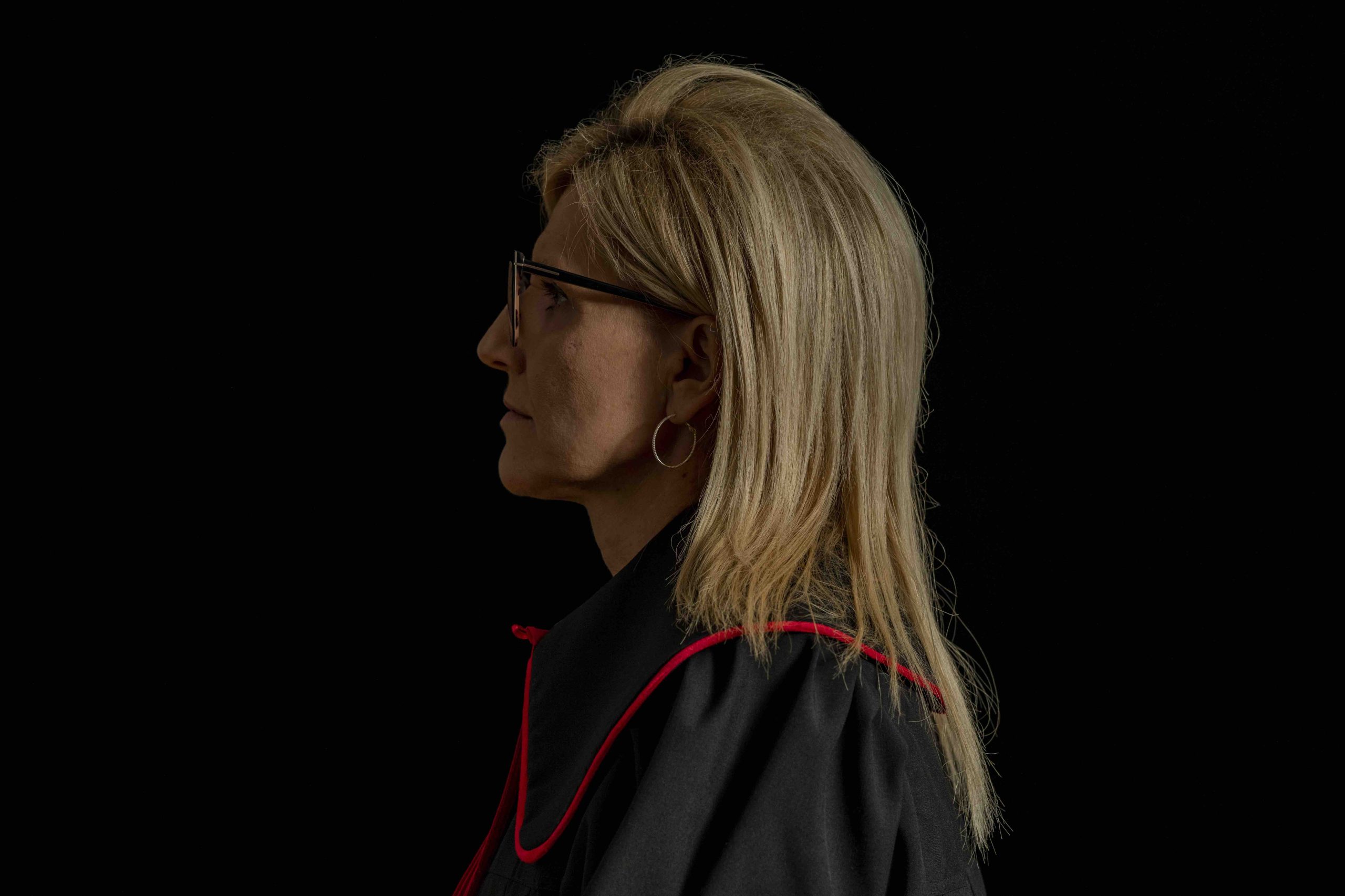
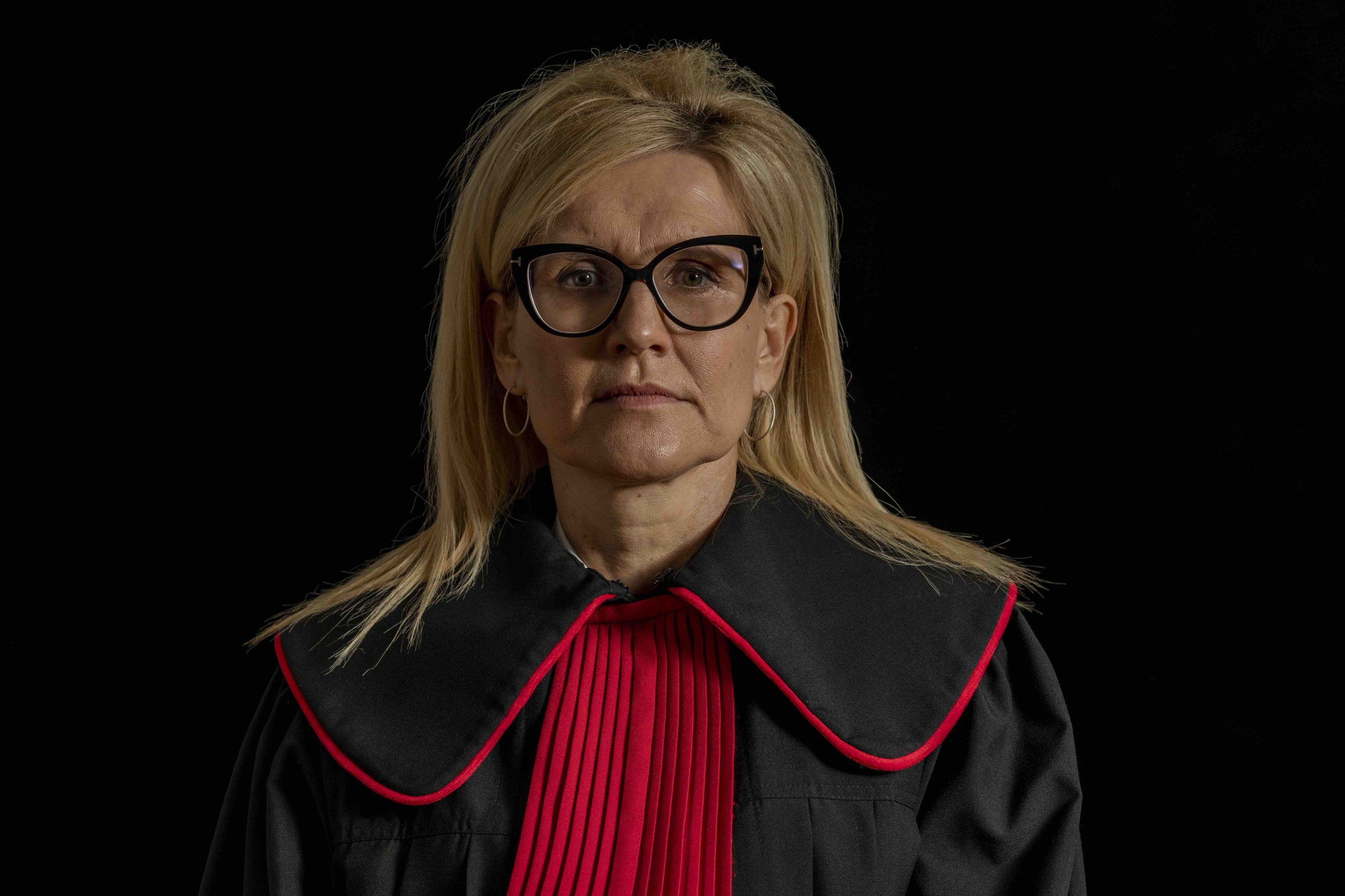
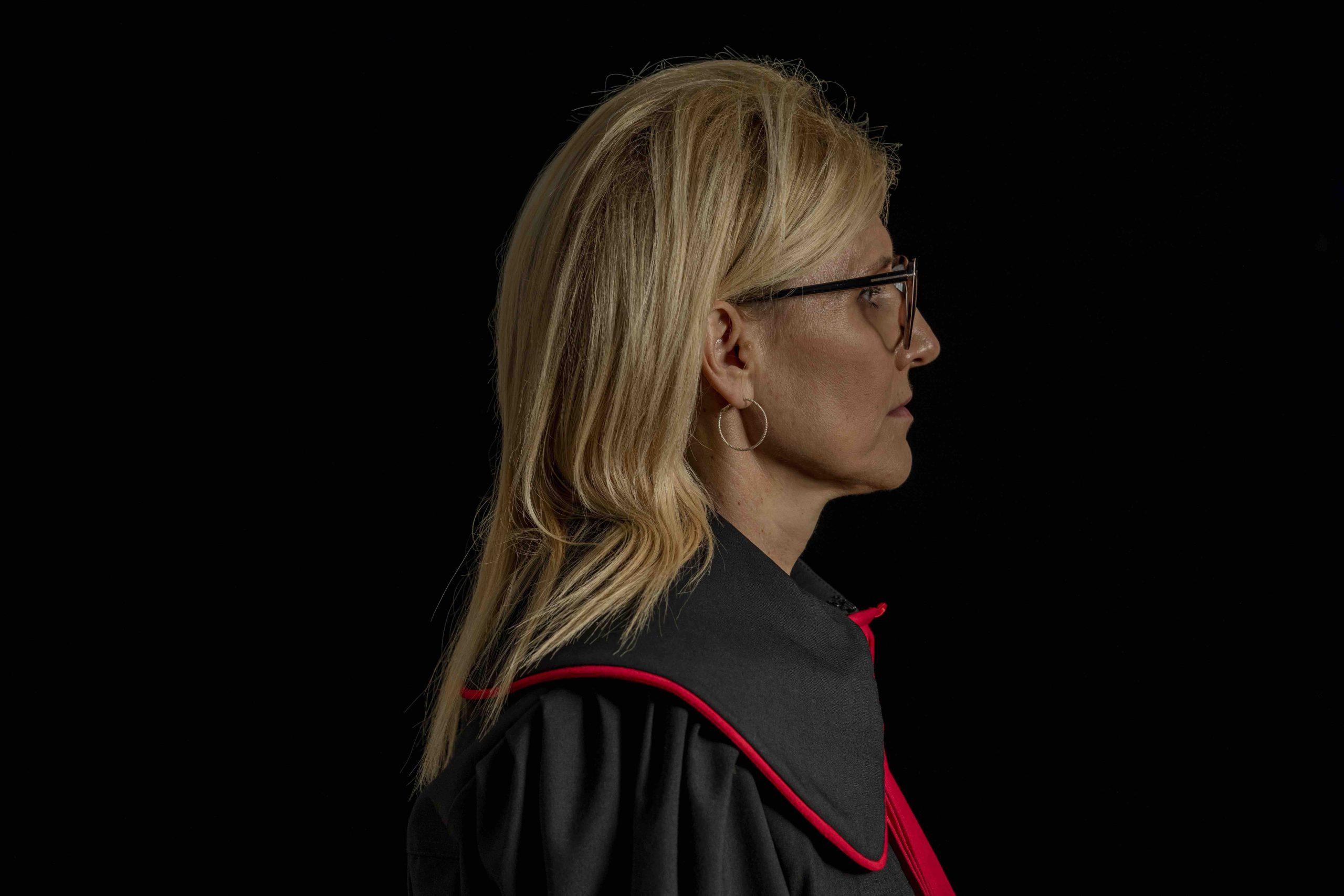
Ewa Wrzosek
Prosecutor since 1994, District Prosecutor’s Office of Warsaw-Mokotów, delegated out to the District Prosecutor’s Office in Śrem (334 km away)
There is pressure, there has always been pressure, and this pressure will probably never be eliminated. Someone always knows someone else and that kind of information always gets back to us and we are made to understand that such and such proceedings should come to a conclusion in this or that way. The strength of a prosecutor lies in the fact that he or she is able to resist these pressures.
•••
Ever since childhood I have been a fan of adventure writer Zbigniew Nienacki and actor Bronisław Cieślak, who starred in one of Poland’s most popular police series, so I generally assumed that I would be in the police. However, no one in my family had any connections in either the police or the law. I got older, understood more and realised that getting into the police was not really the right thing to do. Then came the changes in 1989. I passed my school exams and I was convinced I should go to law school and become a prosecutor. I was a good student, I had an individualised study programme and was drawn to human rights. The training to be a prosecutor was not well respected and I almost did not get it. The law was being changed, the death penalty was being abolished and there were plans to take away the possibility for prosecutors to use pre-trial detention. I was against the death penalty and believed that only the court, as an independent body, could take such a decision. During my exams I argued for not giving prosecutors the possibility to make use of pre-trial detentions and I passed by the skin of my teeth. I did really well during the oral exam. I was able to continue with prosecutor training.
•••
A prosecutor is only human and there are certainly cases that I would not want to handle or cases I should not handle because I am too involved personally. But just because I want to quit a case does not mean I would. The hardest cases for me are those that involve child abuse. I stop thinking about the essential parts of the case and I get a primal urge to retaliate and this could translate into the way I conduct the proceedings. As a young assistant judge who had a small child at the time, I had a case in which a nursery had reported a mother bringing in her badly bruised child. When the carers asked what happened, the mother broke down, burst into tears, and then ran away. After a police investigation, it was revealed that she had been abused by her partner. It turned out that she was the only bread- winner and the man did absolutely nothing. From time to time, he was supposed to take care of the child when she went to work. If the child would annoy him, for example by crying, he would smother the baby with a pillow. It was a horrible, tragedy of a situation. The baby was only 12 months old. I was hit with so many negative emotions. I remember it being a Friday afternoon and the police just wanting to go home, the prosecutor wanting to go home, and I had to go to the nursery to pick up my own child. The perpetrator was detained but it was a Friday and “the weekend was coming, so we’ll give him probation”. Probation is a preventive measure so he would only have had to go to the police station once in a while. In fact, it is a way of pretending that we were keeping an eye on him because he was actually going home. I remember a policeman I knew saying: “listen, we put shoplifters in prison and you have this situation and you’re thinking of probation!? You should stick him in prison!” And then the policeman and myself plucked up the courage and we got on the phone to the court. We ended up filing for his arrest by motion of the prosecutor and it was granted. At the time, I had a sense of duty well done and genuine satisfaction. In spite of my emotions, there was never a sense of routine. I did not think that it was time to clock off just because it was 4 p.m. or that it was a clear case of Stockholm syndrome with the woman not really wanting to punish her abuser.
•••
The most important legal provision in criminal proceedings, which pertains to what a prosecutor actually does, is how proceedings should be conducted. We have to identify the perpetrator of the crime so that he or she bears criminal responsibility and the innocent person does not. This is a benchmark for me. Because of all the work we have, we sometime fall into a routine. It is often said that prosecutors know how a case will end after reading just the first page of the case file. And very often this is the case, to be honest. Perhaps it is down to experience but you have to always remember that making a judgment at first glance can really narrow your field of vision. You have to be extremely open, detailed and not conform to social expectations. I once had a seemingly open-and-shut case: a pedestrian was hit by a car on a zebra crossing. The driver was charged. Unfortunately, prosecutors often do not go to all the hearings of a case and they turn up at different times. I went through the case again and discovered it was far from clear-cut. The driver had indeed hit the pedestrian on a zebra crossing, which is of course unacceptable, and he should have stopped but it turned out that the old lady had wandered into the road without warning. I imagine myself in a similar situation, creeping slowly forward in a traffic jam, noticing a group of pedestrians standing by the side of the road and then suddenly, without any possibility of stopping my car, a pedestrian walks right in front of my car. It is important to remember that prosecutors are required to use life experience to make important decisions – it is in fact written into the law. I asked for an acquittal even though an indictment had been issued. The old lady cried: “what are you doing!” but the driver stood up and said, “Your Honour, I was afraid to come to court, I was terrified of the whole situation but now I will tell everybody that they should go to court!” He was convinced that he would be convicted, punished and maybe even sent to prison. And then out of the blue he was filled with hope and suddenly believed in the justice system and the courts.
•••
I am really good at realistically assessing a situation. Only then do I begin an investigation. That was what happened with the proxy elections in 2020. I carried out an investigation, filed the papers to be signed by the regional prosecutor’s office (because that is our duty) and I left work around 4 p.m. I did not have any high hopes for a proper trial or the hearing of witnesses and I suspected they might take the case away from me. At around 5 p.m. the same day I heard on the radio that the investigation had been dropped. It is astounding to drop an investigation three hours after it has begun. They would have had to bring in a special prosecutor with much less experience than I had and I am sure all the formalities were not tied up when the decision was announced. The most frightening thing is that this is the way everyone now works in the prosecutor’s office, as if there were no tomorrow, as if they will never face any consequences for what they were doing. The real question is why was I delegated out to Śrem, 300km away? They could have stuck me in a grimy basement in Mokotów in Warsaw or given me an impossible task to do. Nobody would have known anything about me, nobody would have cared and nobody would know I even existed.