
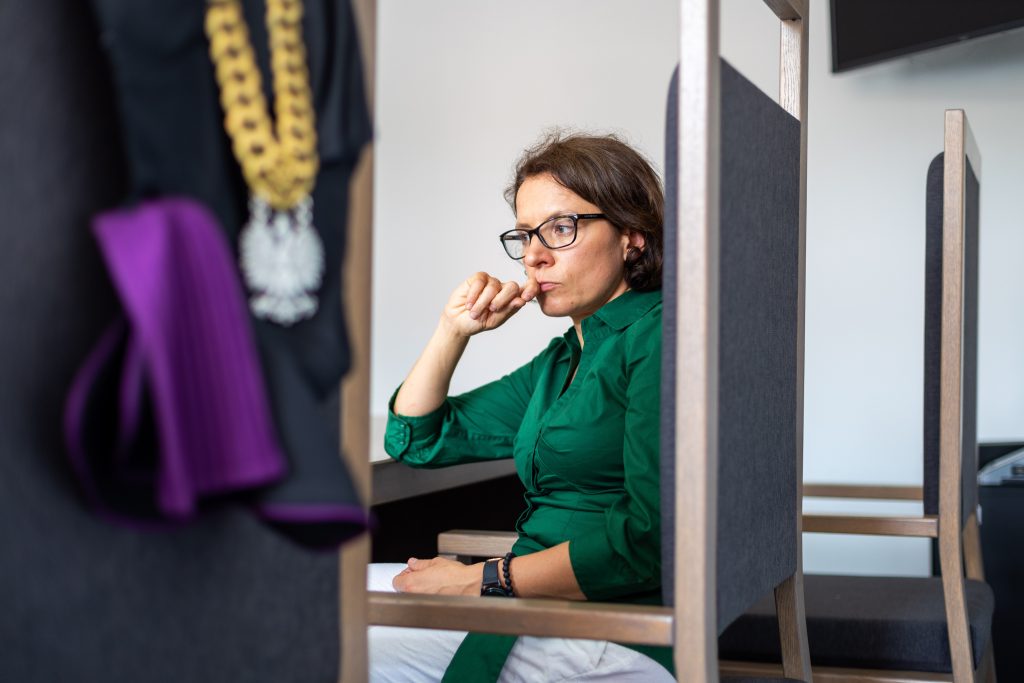
Monika Frąckowiak
Judge since 2004, District Court in Poznań
When a judge rules in today’s Poland, they often have their own problems on their mind − they might be the sole breadwinner in the family or have a sick child and have to pay for treatment, and the suchlike. Then it begins: “If I issue a ruling in this case, will it mean that (state-sponsored) Polish National TV loses?” or “what if the ruling party has a stake in this trial?” The judge then starts to wonder if giving a verdict in line with the law and their conscience will not mean being demoted, or put an end to their hopes of a promotion. This kind of pressure destroys any hope of an ‘independent’ authority.
•••
I applied for Japanese studies, but did not get in. I went to law school by accident; it was the 1990s, the rat race, and law students were a large part of that, although I did not take part myself. I enrolled in a Human Rights course taught by Professor Roman Wieruszewski. He had returned from the Balkans where he had been working in a team dealing with genocide and the refugee situation. There were also judges teaching the course and the way they approached their work convinced me that I really wanted to become a judge: I would not have to work in the world of corporate law but could follow a path that gave me some level of freedom. I wrote my master’s thesis on Human Rights in the EU at a time when Poland was still not a member.
•••
I do not regret any of my judgments. You have to remember that the court system is structured in such a way that there is always the possibility of appealing to a higher court after a first instance judgment. Saying that, however, there have been a few times when I have not regretted the regional court changing my ruling. There was a case relating to compensation for a woman who had her right thyroid removed instead of her left lobe while in hospital. The woman motioned for PLN 50,000 but I awarded her less because the lawsuit was formulated in such a way that it was impossible to award her any more. I really hoped that the verdict would be appealed and the regional court, which has a greater range, would award more. That is exactly what happened, which I was very pleased about.
•••
I should have come to this realisation earlier but I have to confess that, as a judge, I have only really come to appreciate the importance of the Constitution in recent years. It has always been there, of course, but it was always in the background. There were provisions about which there were ‘constitutional’ doubts, and the Constitutional Tribunal would occasionally rule that a provision was unconstitutional but it was all very abstract even for a judge like me. I think most judges had the kind of attitude that: “If anything happens, the Constitutional Tribunal will deal with it; my job is to apply the law, and I have to assume the law is in line with the Constitution”. I started realising the importance of the text that is the Constitution only after the attack on the Tribunal. I started to read what Professor Ewa Łętowska wrote. For many years she had been saying that judges should apply the Constitution directly. That is also my role as a district court judge: to apply the Constitution directly when a lower-ranking provision raises any doubts in my mind.
•••
One of the deputy presidents of my court was very critical of what was going on until he was promoted. He then started saying that “we cannot take a political stance”. So how does that relate to the fact that all the new members of the National Council of the Judiciary were selected by a political party? And he has the nerve to say that we have become political! We have a fake court, fake judges, and fake judgments. We have a fake Constitutional Tribunal. It is so difficult even for lawyers to come to terms with this, let alone citizens who are not au fait with the law. Unfortunately, there are things which we will have to come to terms with. For example, the non-existence of the Constitutional Tribunal, in which there are still three vacant places. There are only three people there issuing rulings and they are not even Constitutional Tribunal judges. We have a court president who is a Constitutional Tribunal judge because she was duly appointed, but is she, in fact, a court president? Not exactly: numerous laws have been broken on the path to her presidency. The same can be said of the appointments of Krystyna Pawłowicz and Stanisław Piotrowicz who have become judges of the Constitutional Tribunal even though they are members of the ruling party. This is actually a question of ethics because the law was not broken during their elections. With this in mind, how can we preserve any kind of constitutional continuity or declare by provision that all these appointments are invalid?
•••
I am an optimist and I believe that, generally speaking, things do have to change. This terrible time that we have gone through has taught us something and the judicial community has become more egalitarian. Before it was very much elitist and there was a feudal attitude in the courts. I am worried that the current situation in the courts may solidify and many dishonest judges in our community will get away with what they have done scot-free. I am not looking for revenge, but we cannot allow political cronies with no moral backbone to rule and judge on the lives of other people.