
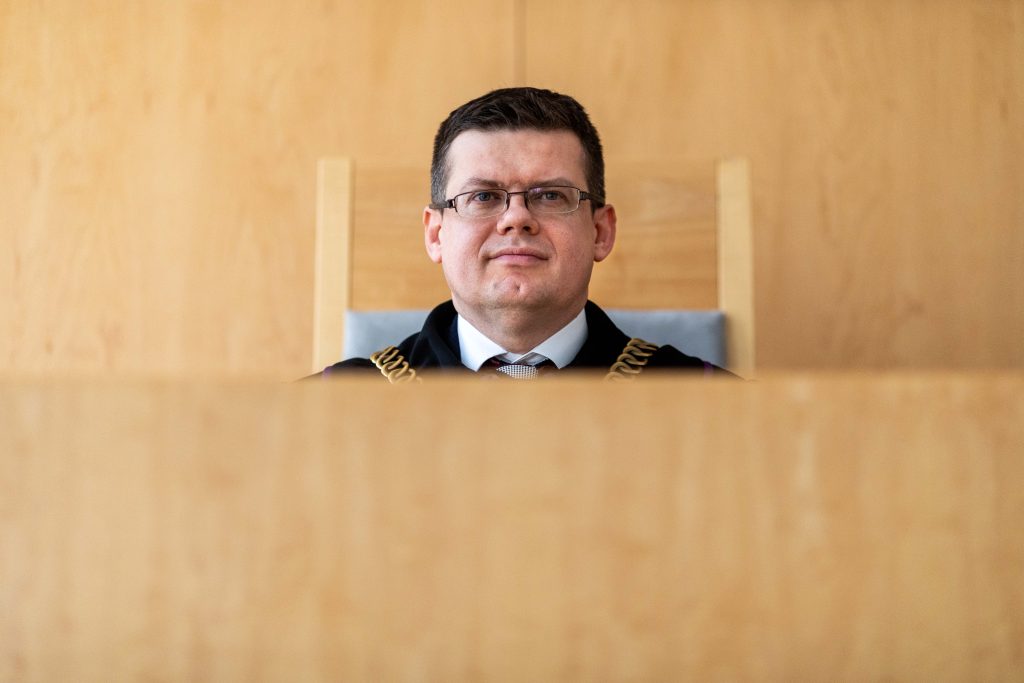
Krystian Markiewicz
Judge since 2003, Regional Court in Katowice, President of the Polish Judges Association “Iustitia”
Independence from political power and the ability to adjudicate freely are the two conditions that must be both met in order for us to use the terms ‘court’ and ‘judge’. Otherwise they will be ‘court’ and ‘judge’ in name only. It is not enough to nail a ‘court’ sign to a building to turn it into an island of justice. Similarly, we cannot turn a morgue into a hospital simply by changing the sign. A court is more than just a building.
•••
You could say that I became a judge at the age of 14 (laughs). I remember when I was in the seventh grade of primary school and an older classmate from my town told me that he was going to study law. The fact that Działoszyce was the “biggest town in the world” with 800 inhabitants (laughs) meant this was a really big deal. Law seemed elite and unique and from that moment on I always knew I wanted to become a lawyer and I somehow subconsciously felt that one day I would become a judge. What is more, it was my mother’s unfulfilled dream. She said that she lacked the courage because she was from a village near Bodzentyn in the Świętokrzyskie Mountains. This was a classic manifestation of the irrational barriers we place on ourselves. Fortunately, she did go to university, but studied history.
•••
My current objective, which is uniquely important, is to defend the rule of law, to ensure that people have access to independent courts. It is often said that courts punish but they defend just as often: they defend those who are weak economically, mentally, intellectually and even physically.
•••
In recent years, I was greatly affected by the Anti-Communism Act. The state passed a law which more or less said: “we will take away the pension rights of certain people on the basis of collective responsibility”. However, the state is ‘gracious’ because it grants citizens the possibility of appeal. But only after the pension money has been taken away! What is more, in order to make it more challenging to assert one’s rights, only one court has been designated as competent to hear this type of case: the Court in Warsaw. Why? In order to clog that court up and not give people the opportunity to find justice, for them to give up before even starting. At the same time, the Court in Warsaw using the instruments it has at its disposal in accordance with the Constitution and the Civil Procedure Code, poses the question to the Constitutional Tribunal about the constitutionality of the Anti-Communist Act. But the current Constitutional Tribunal headed by PiS-backed Julia Przyłębska is not a Constitutional Tribunal and it drags and dillydallies with its answer. So the Court in Warsaw also decides to wait… But not everyone has time to wait. In October 2019, more than 800 people died waiting for this verdict. These are the methods used by those currently in power. It is heart-breaking when you realise that these are deliberate mechanisms being used by the authorities who were supposed to protect citizens from the temptations of political power, and not behave like this. In situations like this I always like to draw attention to the fate of particular individuals. Some time ago, as President of the Iustitia Polish Judges Association, I received a letter from a woman in Częstochowa who wrote that she would fight for the independence of the courts to the very end. She graduated from the University of Silesia and for just under two years, between 1987 and 1989, she worked in the passport office. Now she is disabled (category C). She used to have a pension of PLN 2,150, now she only has PLN 814 (because she worked for the ‘communist authorities’ in the passport office for less than two years). She says she cannot afford to buy any medicine for herself. And she is slowly dying as a result of this institutionally political euthanasia. I do not understand the approach of my colleagues in Warsaw. This woman asked for her case to be heard, which it was not, because the most convenient thing for the Court in Warsaw to do was to wait for the Constitutional Court to wake up. But the woman still has no money for her medication. Despite this, she still has great faith in the courts, the judges and the rule of law. This is also an example of how easy it is to deprive people of everything they have by depriving them of a court. In the future, other social groups may also be deprived of their rights and benefits in a similar fashion. And where will they then go? “To court, of course,” they will answer. But to which court? To the one with a shiny official plaque at the entrance where government-backed officials do the bidding of their political masters? Like Pilate washing his hands of everything and posing questions to the Constitutional Court… We cannot allow the court to become a mere building without any social or moral values.
•••
The March of a Thousand Gowns, which passed through the streets of Warsaw in January 2020, was an extremely important event for me. It was a psychological breakthrough for judges. We had to consider whether “to go or not to go” or “put on your gown or not”. We discussed this with fellow judges (also those from the Supreme Court), professors and representatives of other legal professions, and also wondered what was appropriate and what was not. And then, somewhere between Plac Krasińskich and Miodowa Street, everything changed. In the space of ten minutes, something happened that would have normally taken dozens of years. All those judges, attorneys and legal advisors who said they would never wear their gowns in the street noticed that they were all in fact wearing their gowns. We had all symbolically stepped out of our comfort zone.