
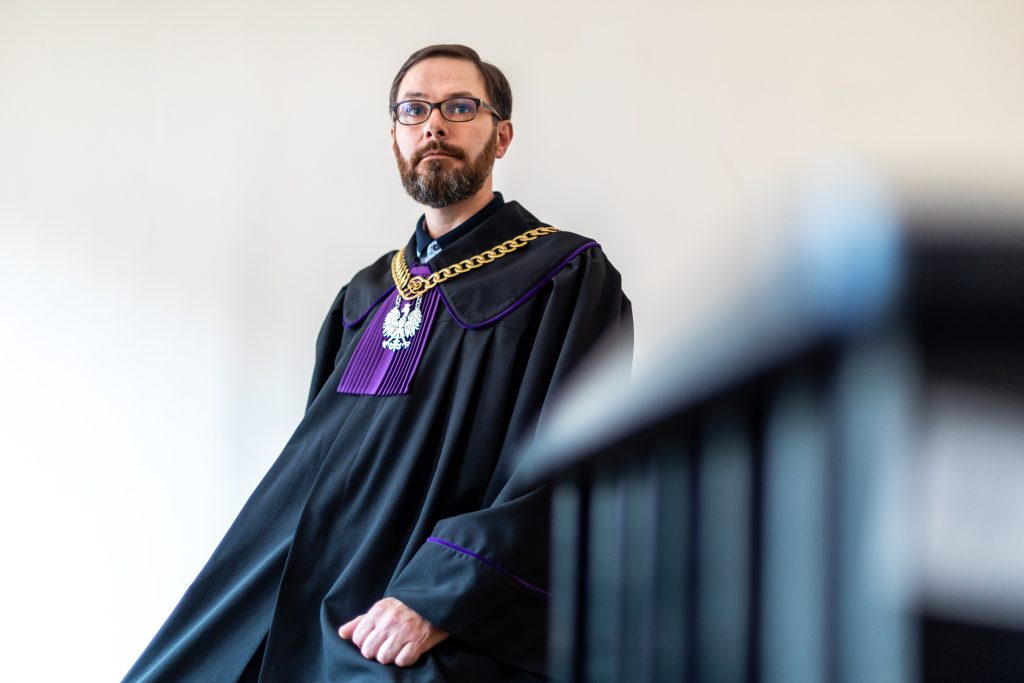
Jakub Kościerzyński
Judge since 2009, District Court in Bydgoszcz
According to Stanisław Zabłocki, Head of the Supreme Court, the Constitution is a set of values adopted by the Nation in a referendum and of these values, two are the most important: Freedom and Dignity. He said this in the Senate defending the Supreme Court against an attack by the political authorities who attempted to bring the most important court in Poland under the control of their own ruling camp. These words have already gone down in history and one could say that they perfectly reflect what the Constitution means to me.
•••
In my application to get into high school – which I have kept – I decided to choose a mathematics and physics profile because my dream at the time was to become a fighter pilot. However, due to medical requirement, this was never going to be the case and I had to decide what to do next. At the time I thought about studying law but passing exams in mathematics and physics was not good enough to get into law studies. Therefore, during my whole fourth year of high school I took history lessons from Mrs. Maria Jadczak. She was my first mentor, teaching me about the modern world and what modern patriotism means. It was Mrs. Jadczak who awakened the humanist in me and I am sure that without her input I would not be the man I am today. Then came my studies, and from the very outset, there was only one choice: if I wanted to be a lawyer, I had to be a judge. In my final year at university, I learnt that I had cancer: malignant granuloma. As a result, I had to undergo a long and arduous treatment and combined preparing for my master’s thesis exam with aggressive treatment which involved chemotherapy and radiotherapy. It was a strain on me both physically and mentally but I overcame it largely thanks to the support of my wife Joanna and the wonderful doctors. I completed my degree with good grades.
•••
I started adjudicating cases at a time when the district courts dealt with cases like the regional courts do today, cases involving organised crime, multimillion-dollar fraud, i.e. big cases. There were so many that it was difficult to keep track, around 300 all being run concurrently. It was important to delve into them, analyse them and give a just verdict. It was hard work, often at the expense of time for my family. Different regulations were in force then, and pre-trial detention was used much more frequently. On a ‘good day’ I would have a Ponzi scheme case with around a thousand victims. The files would amount to around 50 volumes and the sentence was over 50 pages long, as far as I remember.
•••
The changes to the judiciary that have been introduced in the last five years are all about politicising the justice system and making the courts and judges fully subject to political power. In other words, it is about the ruling party taking control of the judiciary so that it can illegally violate those human and civil rights that are guaranteed in the Constitution without any consequences. Let me stress that there have been no reforms that have, for example, sped up court proceedings, simplified them or even made the work of judges easier. The ‘pseudo-reforms’ that have been introduced, for example, in the Criminal Procedure Code, are in many cases directly unconstitutional or violate the European Convention on Human Rights. The problem is that we do not have a Constitutional Tribunal in Poland anymore that would rule that these laws are defective. The current Constitutional Tribunal headed by PiS-backed Julia Przyłębska lost its independence to politicians a long time ago, as evidenced by the fact that it is full of imposters and the decisions being taken there are highly political as was the case with the decision on changing the right to an abortion mainly on the grounds of fatal foetal abnormality.
•••
To be independent is to be courageous and not afraid of making a ruling that is in accordance with the law and one’s own conscience and which could be inconvenient for the political authorities, regardless of the consequences that may befall us on the part of those authorities. Such rulings were made by, among others, judges Igor Tuleya and Paweł Juszczyszyn who for this reason were removed from sentencing and deprived of a significant part of their salary by a decision of one of the chambers of the pseudo-Supreme Court known as the ‘Disciplinary Chamber’. It is not a court in any sense of Polish or European law and all judgments and decisions issued by this unlawful body are invalid in the eyes of the law. What is more, to be independent means that you cannot be promoted on the basis of an unconstitutional and highly political judiciary or nomination procedure created by politicians contrary to European law in which the abilities of someone who wishes to be a judge are less important than his or her loyalty to the ruling political party whose aim is to dismantle the rule of law in Poland.