

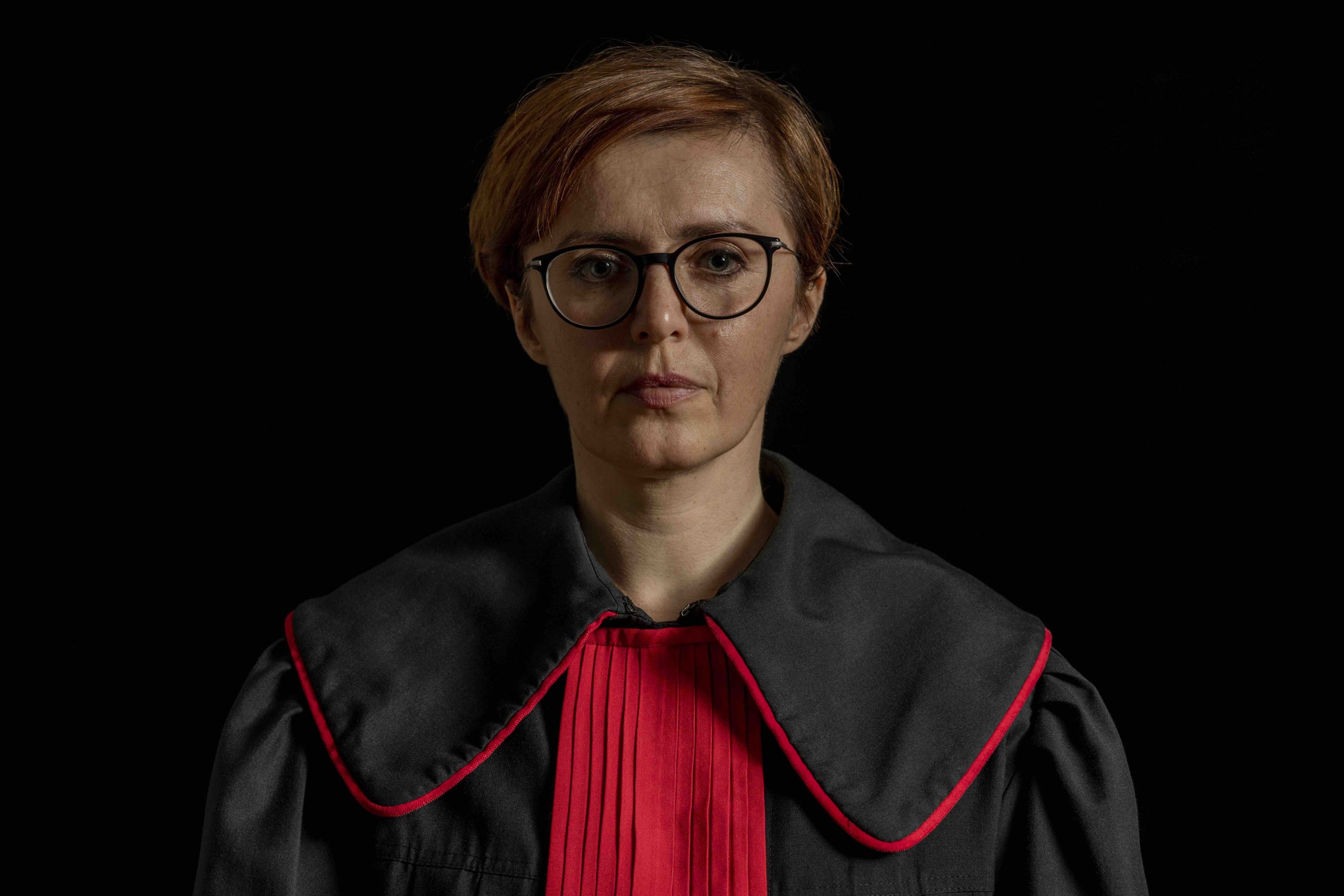

Justyna Brzozowska
Prosecutor since 2005, Regional Public Prosecutor’s Office in Warsaw
In my opinion it is extremely difficult to pinpoint the most important provision of law. The system of law as a whole should be a compatible set of rules in which every article is important. For me, however, human rights are particularly important, including the key right of respect for human dignity under Article 30 of the Polish Constitution. This is the pillar of all other freedoms, liberties and civil rights that flow directly from the Constitution. I understand this to mean that every person has the right to self-determination, to decide for themselves, and it is the duty of others to respect this right. In accordance with Poland’s Constitution, this right belongs to everyone, irrespective of whether they are citizens of Poland or not, whether they are a woman or man, whatever their sexual orientation, whether they are a member of a particular church, whatever they believe in, whatever their financial status or social standing. This right applies to everyone, regardless of their behaviour, regardless of who they are, which is why we have a duty to respect the dignity of criminal suspects, that is to say, people who in our opinion do not abide by the established rules. Even if their actions are wrong from the point of view of the interests of society, they still have this absolute, inalienable right which they acquire at birth and possess until death.
•••
I became interested in human rights when I was still at high school. I won the Human Rights Olympiad organised by the University of Toruń which gave me admission to law school without any entrance exams. Human rights are the most important thing to me. It is the base, the pillar upon which all other rules governing a given community should be established, including legal regulations. I became a prosecutor by accident because I did not have time to apply for the judicial training apprenticeship, and as my friends had chosen the prosecutor’s bar training, I followed in their footsteps. It was a happy coincidence because it turned out that what I chose to study happened to be the most interesting legal profession. Despite the fact that the Internal Affairs Department of the National Prosecutor’s Office has filed an indictment against me in connection with my refusal in 2015 to open up an investigation into a case that concerned the reprivatisation of Warsaw properties, I still believe this to be true. After the change of power in 2016, the National Prosecutor concluded that by issuing such a decision I had not fulfilled my duties and had committed a so-called formal offence under Article 231 of the Penal Code. The non-court that is the Disciplinary Chamber of the Supreme Court has withdrawn my immunity and, as a consequence, I could go to prison for three years for doing my job as a prosecutor.
•••
I work in the Economic Crime Unit where I handle cases involving hundreds of documents as evidence. These cases often involve sectors or industries about which I have little knowledge and which require me to explore new areas of expertise. Currently, my workload includes, among others, cases involving fraud committed using blockchain technology, irregularities in the management of investment funds, money laundering, and carousel fraud. Working on such cases involves great intellectual effort and requires me to constantly stay educated and keep training. This is compounded by the technical limitations that is the everyday life for prosecutors in Poland. I handle fraud cases related to online cryptocurrency trading on my own phone because, despite it being the 21st century, prosecutors in Warsaw still do not have access to the internet at their desks. In the courtroom, we often come up against defendants who are represented by several lawyers specialising in particular aspects of law, often university lecturers, authors of commentaries on various areas of law whereas only I am on the other side. Nevertheless, I believe this is a truly great profession where you can do some good and really help a person who has been wronged.
•••
The principle of legalism applies in Poland. If the public prosecutor has evidence that indicates that a crime may have been committed, they are obliged to initiate preparatory proceedings in such a case. On the other hand, if there is no evidence to support such a suspicion, the prosecutor may not investigate and is obliged to refuse initiating proceedings. A public prosecutor is independent and free to assess the evidence at their disposal which means that they assess it on the basis of the law, their knowledge and their experience. A public prosecutor acts in line with the law and within its limits. The assessments they make must be the result of their own analysis and must not be an expression of any expectations or external pressure.
•••
Criminal law is a branch of law that should be used as a last resort. Many conflicts between citizens are civil in nature and criminal law cannot interfere in them. In my view, this is particularly important in economic matters where it is often difficult to draw the line between freedom of economic activity, acceptable risk and a situation in which I am dealing with a crime. Criminal law should only apply when a person’s behaviour ticks all the boxes of a specific crime. There is always a person on the other side for whom the very opening of an investigation, even without any criminal charges being brought against them, may mean the end of their professional and personal life. Meanwhile at present, we often see the Prosecutor’s Office working on the principle of “let us open an investigation and see if something comes out of it.”