
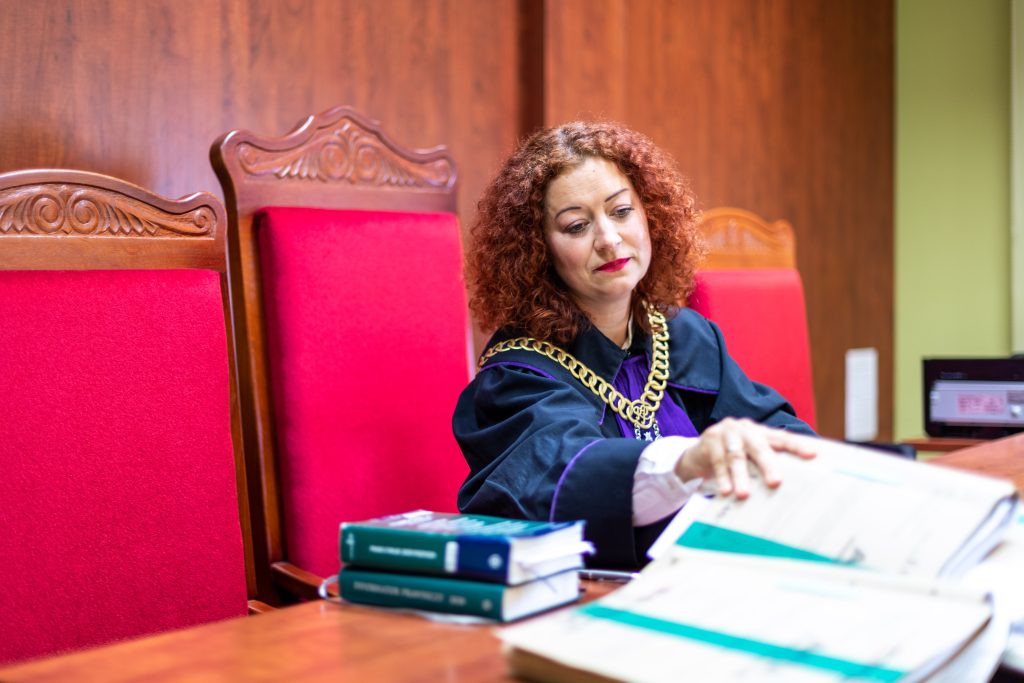
Olimpia Barańska-Małuszek
Judge since 2005, District Court in Gorzów Wielkopolski
There is already so much chaos in Poland that it is difficult for people to understand or describe what is happening at the highest levels of government, whether it is legal or illegal. My role as a judge is to point the finger and say look, this is illegal.
•••
I actually wanted to do a degree in the Monument Conservation; I even learnt chemistry and how to draw. I thought about studying History of Art. In high school we took part in an international mock session of the UN run by teachers from the Peace Corps. I felt very at home suddenly dealing with resolutions, international law, and hearing about human rights. This was the spark that led me to study law. I wanted to be a prosecutor, and also thought about being an attorney at university but when I went for an internship in a court in Poznań, I realised that only judges have the possibility and authority to change the world with their decisions.
•••
The law is like a computer system. Nazi Germany and the Third Reich came into being thanks to lawyers. The communist states introduced new regimes thanks to lawyers. Every authoritarian regime needs lawyers to legitimise its actions, someone to rubber-stamp every decision and legalise the regime’s actions. Even authoritarian regimes are aware that a legislative smash and grab is not only conspicuous but might incur the wrath of citizens. However, if the common man was served a dish which was inedible from a legal perspective but garnished with various legal trimmings, it would be much easier to swallow. The authorities try to use constitutional provisions in a non-systemic way, picking and choosing a “piece of one provision here, an excerpt there and, hey presto, it’s legal. I can do it! I’m entitled to it!” This is a purely instrumental way of using the law and it is in bad faith.
•••
We still have discussions on how to justify our judgments in the courtroom, what will be the best language to use in our justifications i.e. should we express ourselves in a simple way or allow ourselves to use more challenging vocabulary? Do we have a duty to explain to the parties in the courtroom what their procedural position is? Should we explain, provide information and tell them where they can collect their documents? Or should I just gruffly close the hearing and ask the parties to leave?
•••
In 2005-2006, the Polish legislature introduced a lame provision. They made the mistake of allowing hospitals to enter into restructuring settlements with notified creditors. However, hospitals only notified some of the creditors, those who were willing to settle. It turned out that restructuring agreements were concluded without the participation of other creditors, which was clearly unlawful. That was the first time in my life, and probably the first such decision in court, in which a ruling was taken on the basis of the Polish Constitution. I overturned the hospital restructuring agreement on the basis of the Constitution. At the time I did not really consider if this could be done or not because it seemed obvious to me but ten years later we have begun asking in a wider public debate whether a judge can rule on the basis of the Constitution. I was not afraid then, but today…? Should I be afraid?
•••
Over the last 15 years I have learnt the difficult way that being a judge is a service. For the first few years in the job, when I was an assistant judge, I was cocksure and self-opinionated, and I believed that because I had passed all my exams I was clever enough to impose my judgment on other people. But now, and this comes with age, I am at the stage that I understand that a judge must serve the people. The state should enable me to carry out my service independently and impartially and provide those that work in court with decent working conditions. The state should create laws that are functional, sensible, necessary, that do not complicate things, but rather make our lives easier. However, the functions of the state are out of synch. The state is performing its duties on behalf of its citizens increasingly rarely and people are losing the protection of the shield that is the law while others are even being discriminated against.