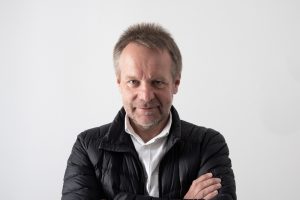
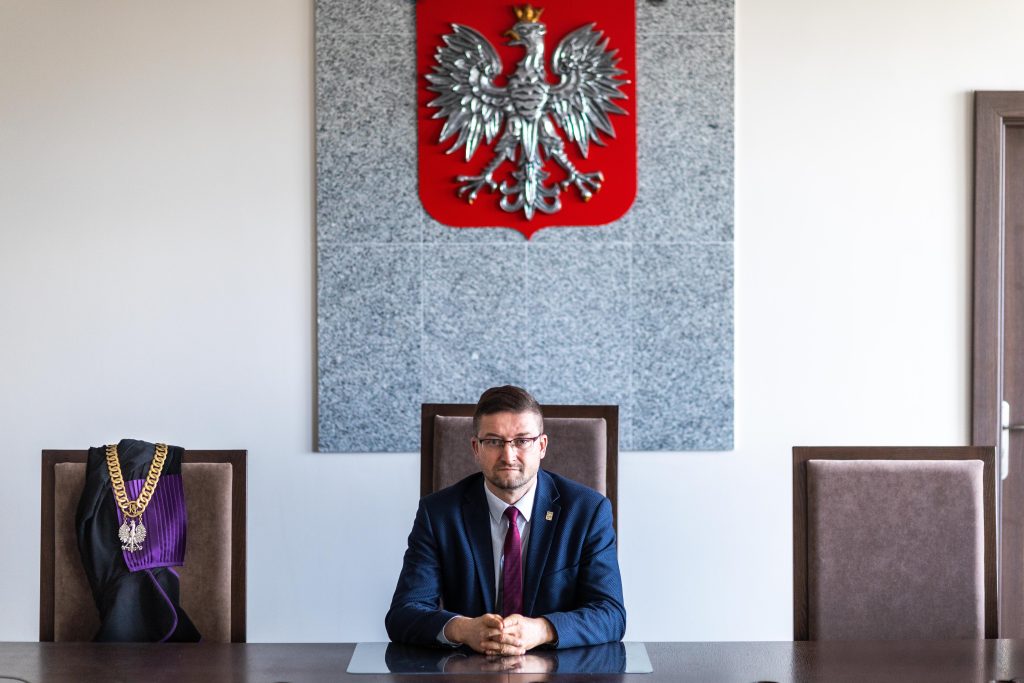
Paweł Juszczyszyn
Judge since 2001, Olsztyn District Court
The state should serve its citizens and ensure their security. It should give them the opportunity to function freely in society. One of the basic principles of law is equality, which is increasingly lacking in Poland. If the state wants its citizens to obey, to pay taxes, to behave in a certain way or to restrict their actions, it must first guarantee clear principles of freedom. It must define the limits of this freedom i.e. where one person’s freedom ends and another person’s freedom begins.
•••
I chose to study law as it would provide me with a decent and proper education, even though there were no lawyers in my family. I did not come from a rich family; my parents were teachers and I knew I would have to look after myself in life. At the end of high school, I was not sure what I wanted to do and law seemed quite specific. I thought about becoming a legal advisor or attorney. After my last year of university, I took a three-month holiday in the Tatra Mountains. I completed dozens of mountain walks but when I came back the bar exams had already finished. I worked for a company for a year where I often could not say what I thought, I could not follow my conscience, and I had to subordinate everything to the good of the client. I already understood then that I knew how to prove and argue a point. A judge – an in- dependent judge, that is – has this comfort of course, the comfort of being able to act according to his conscience. Nowadays, this is the case only if he has the courage to do so…
•••
In the civil cases I specialise in, the judge should encourage the parties to reach an agreement and look for a compromise solution. There is a great saying: if all the parties are unhappy with the outcome then it means a good judgment has been reached. We often hold discussions with people during hearings because the judge is not there just sit like a statue and listen. It is extremely satisfying when you can really explain something, convince the parties to reach a solution that does not fully meet their expectations, and persuade them to reach a settlement. Old and experienced judges say that the worst settlement is better than the best judgment. Young people often think that the law is made up of dusty old regulations, a pile of memorised knowledge and everything needs to be settled by a regulation but actually in the actual practice of law, applying a specific provision is life itself. The law does not give us a simple recipe, especially in this day and age when we are facing fundamental issues where the legislature is able to pass laws that are unconstitutional and even pass laws that outright violate the fundamental rights and freedoms of citizens.
•••
At present, certain violations of the law instigated by those connected with the ruling party are not being prosecuted at all. Civic behaviour that conflicts with the interests of the ruling party is prosecuted ruthlessly and even oversteps the law. However, the courts continue to defend their own independence, continue to rule in favour of citizens and are critical of police behaviour, especially against citizens who are simply manifesting their opinions, often on the streets, which is their constitutional right. Unfortunately, we can no longer be completely confident in the constitutional nature of laws nowadays and the destruction of the authority of the Constitutional Tribunal only adds to this. Previously, any court could pose legal questions to the Constitutional Tribunal, even first instance courts like district courts and this would not be a rare occurrence. As far as I know, however, in practical terms courts no longer address questions of constitutionality to the Constitutional Tribunal.
•••
I am worried that our the society will simply not have enough determination to repair the current situation and this state of disrepair within the legal and justice system will remain for many years to come. Some people will surely use the argument that for the sake of peace and stability, let us leave things as they are, draw a line under everything and do what we can to build something good for the future. However, we cannot build a future without strong and stable foundations, without an independent judiciary. We cannot allow politically-appointed people to sit in the courts.
•••
I am not scared of making decisions. One of the reasons is that mountaineering has shaped me because you have to take decisions lightning-fast in the mountains, often in a split second, reflex-like. And in the mountains, decisions hold weight. For example, I avoided an avalanche thanks to my fast reactions. On another occasion, I managed to protect my friend and pulled him out of a difficult place; we were later evacuated by helicopter from the Grossglockner, the highest peak in Austria. While in the Karakoram, I pulled a doctor friend out of a glacial crevasse into which she had fallen. Decisions in court are also about assessing a situation and reacting appropriately. Such decisions are often made in two instances in order to avoid making a mistake. Someone might say: “That judge was terrible because he ruled against me, and the court of appeal was good because it changed the ruling in my favour”. However, looking at it from a broader perspective, both courts, the first and second instance, have fulfilled their function. Each court rules according to its own conviction and its own understanding of the law because the law is subject to interpretation and all of this is done in order to achieve justice.