
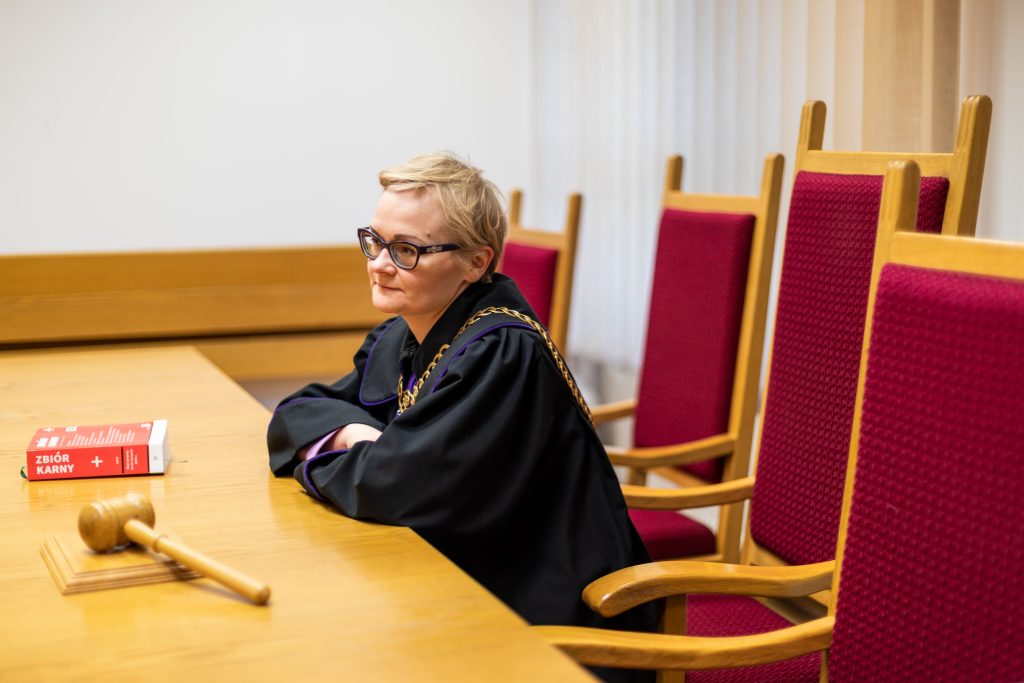
Katarzyna Wróbel-Zumbrzycka
Judge since 2006, District Court for Warsaw-Wola
I am afraid that we will either burn out or our fire will go out. We are strong but we have been standing ‘on the barricades’ for five years now. The road is long and we still do not have the end in sight. I know full well we are on the right side but I have started thinking about the cost. And it is not a fear of the consequences from the authorities. It is more about how to deal with the fatigue, impatience, bitterness and anger. It would be difficult without the support of the people who stand beside us.
•••
When I started working as a judge it turned out that I could only try criminal cases because there were only vacancies in the criminal division. I was in tears because I did not want to deal with big crimes. I thought I had chosen a profession that would be more about determining whether a contract was valid or invalid, a clean and simple job. Now after 13 years, I have absolutely no regrets. I am convinced that criminal law is at the heart of the profession and it would be difficult for me to do anything else. Criminal cases are often zero-sum. You have to pull yourself together, assess the evidence and say “you are guilty” or “you are innocent”. You cannot adjudicate ‘only a little’ or decide to ‘kind of’ not adjudicate. That is the strength of a ruling. And at the same time that is our great responsibility.
•••
Drug-related issues really affect me. I am not only affected by the people who possess drugs but those who are infected with this disease, those who suffer the most terrible of addictions. More often than not, they are lovely people who should have their whole life ahead of them but have a huge mess instead. I think of their mothers, partners, and children. I am also affected by cases involving families. The worst are the violent cases where you see all those women with their bruises but also those cases where you get the impression a couple is mismatched or a couple who was once close are now fighting and are now unable to communicate with each other. The most difficult cases are always those involving child victims, especially if you have a child yourself. We all have cases in our files that we would prefer not to open.
•••
The most important provision for me is probably Article 5 of the Criminal Procedure Code which states that everyone is presumed innocent until proven guilty, established by a final court judgement. And that all doubts are resolved in favour of the accused. This is a rule that took me a long time to learn how to apply.
•••
Paradoxically, I find it easiest to try big cases, for example involving organised crime. These are trials where you have to establish the specifics i.e. the quantity and types of drugs that have been sold, the circumstances surrounding the transaction, and the credibility of the witnesses. They can be complicated because of the volume of evidence but in reality they are zero-sum. The defendants we come to judge are often people who are aware of what they do for a living and have great respect for what goes on in the courtroom. They know that we have to go through all the procedures to pass judgment and in reality it is all quite simple.
•••
I still wonder and am still searching for the answer of whether the judicial profession is a service, a mission, or perhaps something to be defined some other way. It is certainly a job, activity, and profession that requires great responsibility and sensitivity. Without sensitivity, this profession could not be carried out. Intelligence and incisiveness alone are not enough to be a judge. After over a dozen years of trying criminal cases, I get the impression that without sensitivity we would lose our humanity and without that we would lose justice. I became a judge so that I can help people solve cases that they themselves are unable to resolve as they do not have the power vested in the judicial office. This profession can only be exercised when there are no doubts, i.e. as long as I know that I am making a decision that is not only in line with the law but also takes into account the actual person in question as well as all the contexts of their actions. I do not know whether it is all more a question of willingness or courage to be able to look at a case as broadly as possible, without hiding comfortably behind a legal regulation which after all only describes a tiny portion of our life. And this is also strictly intertwined with the independence of judges for me.