
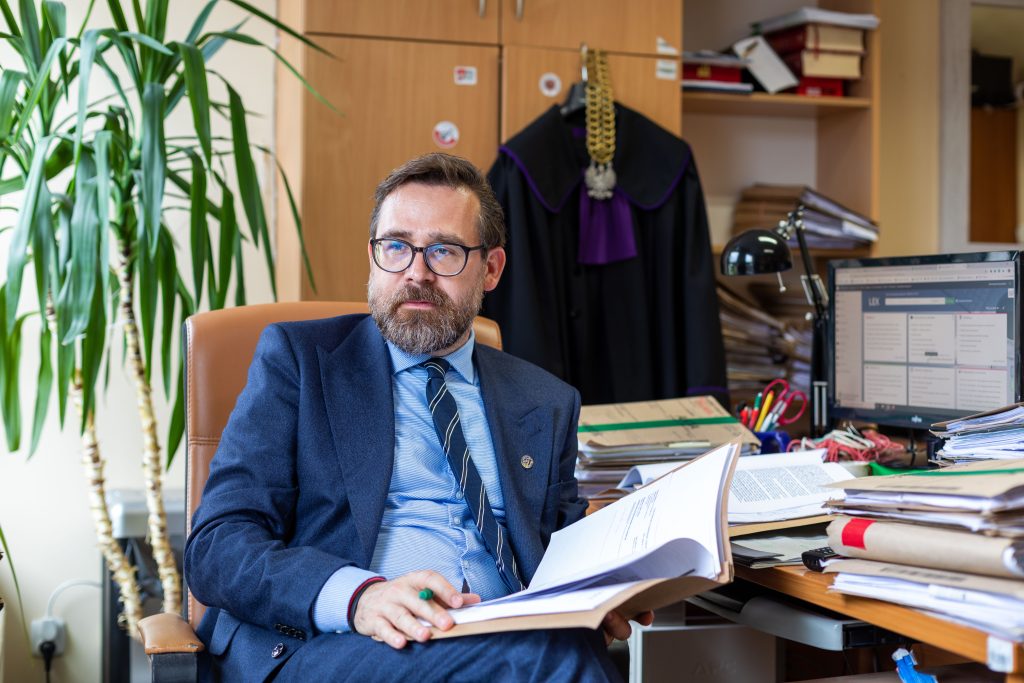
Bartłomiej Przymusiński
Judge since 2007, District Court of Poznań-Stare Miasto in Poznań
I believe the Constitution is a shield which is supposed to protect the rights and freedoms of citizens. It is supposed to keep each government in check so that it does not become an oppressive power which is used against the citizen. It should ensure that everyone’s rights are protected, including minorities. It is a contract that society has agreed upon and everyone – especially the authorities – must abide by.
•••
I wanted to become an attorney like my father but during my studies one of the lecturers in civil law, Stefan Rzonca from Kraków, encouraged us to visit a court to see how the law worked in practice. He was a judge at the Regional Court in the civil division so it ideally complemented the subject he was teaching. When I started going to these hearings, I was fascinated with the profession of judge and I saw that searching for the truth in a courtroom can be truly enthralling.
•••
The gown, the chain of office, the bench, the table, and the other chairs all come together to make the institution of the judge inaccessible, almost temple-like; it is so archaic. A good judge does not need a gown, a bench, or even a throne to have authority. In civil and family matters, it would probably be much easier to reach agreement with both parties in a trial if these archaic attributes and the whole setting were not there. An ideal situation for a judge is to solve the problem that people have and not have to announce: “you were right and you were wrong; you win, you lose”. In Germany, courtrooms in civil and family cases are often rearranged so that no two parties sit opposite each other; there is a round table around which the judge and the two parties sit – everyone is equal. They do not have the whole theatre that permeates courtrooms in Poland because judges have not been fenced off from the rest of society. After all, before the protests about the judiciary began, judges were seen as lonely figures sitting in their ivory towers who only speak to announce a verdict which is not really understood by anybody anyway. It might take a judge at least an hour to read out a verdict in a criminal case in which the regulations are unknown to most people. He might first announce that he is imposing a sentence of three years’ imprisonment only to announce a moment later that the sentence has been conditionally suspended for five years, for example. With that in mind, I think it has been a great success that many judges have overcome their inner reservations and joined the people who have come before the courts to often initiate the protests against the government. For most of us, it would have been unthinkable to take part in these kinds of protests in the street.
•••
I am worried because the government has passed the so-called Muzzling Act which means that if you try to question the status of another official (who has been appointed in a defective manner), i.e. questioning the appointment of a judge, could mean facing disciplinary procedures. That is how the disciplinary ombudsmen currently operate. I worry that fear of disciplinary procedures might determine the ruling I make. And that would be the moment when I would have to take off my gown and stop being a judge.
•••
The key to reversing this situation is the appointment of a new National Council of the Judiciary, but this will require a majority in Parliament to pass a new law on the National Council of the Judiciary. This will certainly be based on the choices the people of Poland make. The case law of the European Court of Justice in Luxembourg may also have an impact to some extent but only in a limited capacity. Thanks to being in the European Union, the destruction of Poland’s judiciary will not happen as quickly as in Turkey where inconvenient judges have simply been imprisoned or thrown out of the profession.