
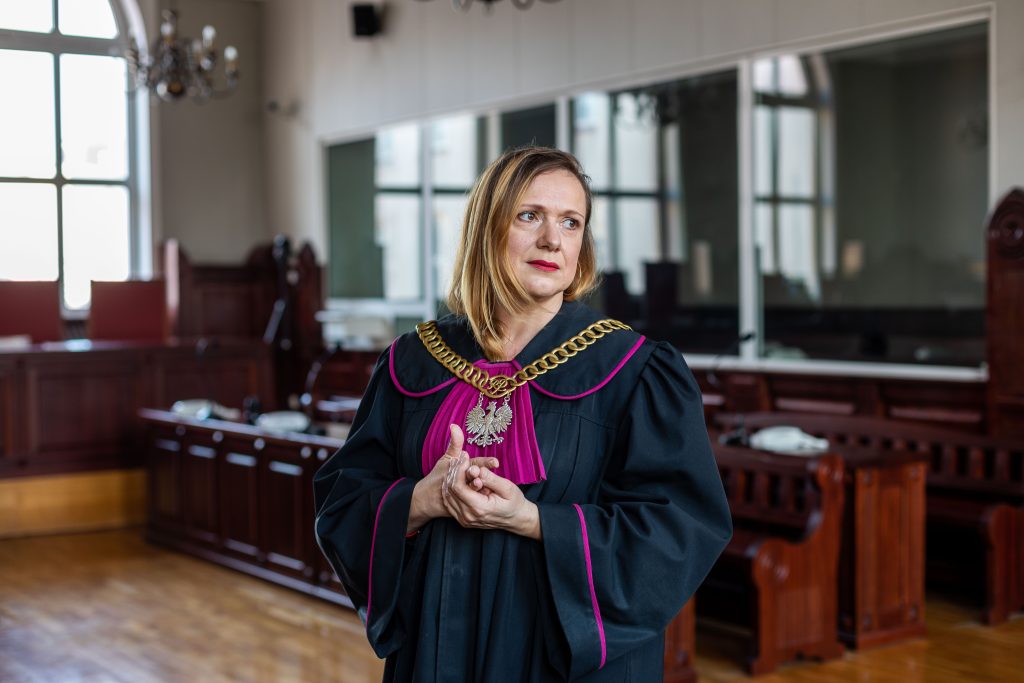
Joanna Hetnarowicz-Sikora
Judge since 2006, District Court in Słupsk
Everyone has inborn dignity. Human dignity is a source of everyone’s rights and duties, a source of the rights and duties of every citizen. Dignity cannot be violated and the state has a duty to protect it. In fact, all state bodies should respect human dignity. This is the true essence of the law.
•••
I was from a teacher’s family. In high school I thought I would work for a humanitarian organisation. I wanted to dig wells in Sudan, just like (Polish humanitarian) Janina Ochojska. I saw myself there although my mother did not like the idea very much as I was a top student. To keep the peace, I went to law school. After all, you can still work in an international organisation after studying law. And that was the plan. However, I got pregnant in my fourth year of studies and it turned out that it would not be so easy to work, for example, in a UN mission in Burundi because I now had to start being responsible not only for myself.
•••
My eldest son really hates what I do. As a child, he fought to get my attention and he lost out more often than not. All those cases and piles of files that I brought home, writing justifications at weekends, and worrying about other people’s misfortunes meant that my own life and the life of my loved ones had to take a back seat. Work always came first. I would send my parents or my sister to my son’s birthdays and they ended up actually bringing him up. I could not be there because there was a court hearing, people were waiting, or I had to finish writing a justification for the next day which could not wait. I have this feeling that my work has taken something away from him. My son is proud of me but he is also angry in a way because of the place my job has taken in our lives. I have another son who is ten. After he was born, my sister quit her job to be home with him for three years. I had to go back to work “because people needed me…”.
•••
Let me talk about fear. At work I sometimes have to deal with insurance fraud cases involving extortionately high ‘prangs’. In such cases, the people involved in the accidents and penalised by the police are often questioned. I listen to these witnesses who have been fined and the standard question is always “What happened when the police arrived?” And the answer is nearly always the same: “What do you mean, what happened? What do you mean, what happened!? The police gave me a ticket!” I then ask: “But did the police tell you that you have the right to refuse the police ticket?” And they say, “But ma’am, you do not argue with the police! The police are always right!” That is the moment I find really hard and sit there in the courtroom wearing my my official chain and gown. I would really like people to be aware of their rights, to know when they can demand something and not be afraid to do so. As a society, we have so little knowledge about our actual rights that we do not even notice when our rights are being taken away from us! And we do not even protest about it!
•••
Recently, a judge was wondering whether by applying the law and acting within the limits of the law he might open himself up to, for example, disciplinary proceedings. He wonders whether by doing so he might be risking his professional life. This is unacceptable, of course. It goes against the very principle of judicial independence. A judge should not have to weigh up the benefits and costs to himself when making a decision. The only thing that should motivate him is a sense of justice.
•••
Judges live like they are behind a glass wall. We live to one side, without getting involved in wider relations with other people because that is the peculiar nature of our profession. For example, I might avoid going to the pub with my neighbours. The very idea that someone in my courtroom might have seen me dancing with a neighbour! What a thought! We do not need that kind of trouble. I have been in situations where I was on my way to a friend’s birthday party and one of my neighbours called out: “OK. We are on our way as well!” I then replied, “Great, you go on without me, I am going home”. And that was the end of our evening together. Judges have not really let ourselves be known as real people. We have always avoided being seen in ‘normal’ situations like digging in the garden or pumping up our bicycles in front of a super-market. This has turned against us because nobody understands our human, normal side now, and as such it has been easy to create the caricature figure of the ‘terrible judge’.
•••
In Hamburg in 2016, during the ‘judge exchange’ I saw that there are countries where people are not afraid of the courts. They go to court full of confidence in a judge’s decisions. Judges talk to people in the courtroom without losing any of their authority! A witness is allowed to sit while testifying, for example. The judge does not have to keep ordering the parties to ‘stand up’ or ‘sit down’. It is easier for people to accept the decision of the court in this kind of atmosphere. It is an empowering experience.