
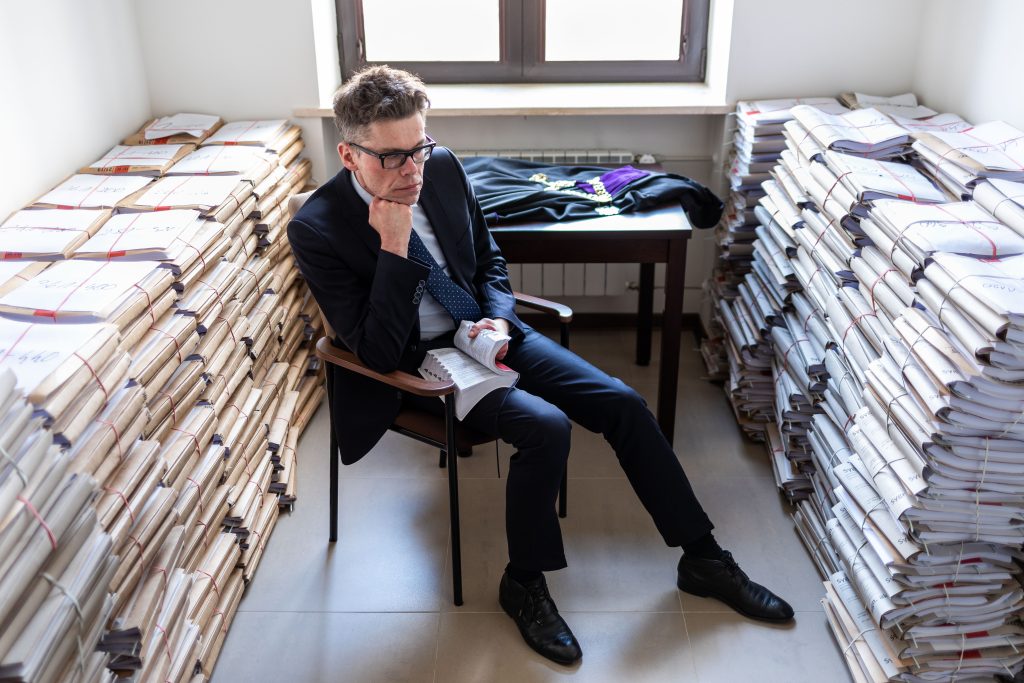
Igor Tuleya
Judge since 2004 , 8th Criminal Division Regional Court of Warsaw
A new model is emerging before our eyes: that of the civic judge. They are no longer confined to the four walls of a courtroom and no longer limit their activity solely to judging and justification. A judge should go out to citizens, meet with them and talk to them about what a judge does. They should also learn from citizens and engage in dialogue with them about changes in the law and the judiciary. This is important and I believe this is how the authority of judges and citizens’ trust in the judiciary are built.
•••
I went to law school by accident because there were a lot of free places. I wanted to go to university to not get called up by the Army Recruiting Command and then try and work abroad. I hoped that later I would be able to study another subject. I took humanities in high school so I thought more about studying History or the History of Art but there were not many free places to get in. Years later, at the end of my studies after an internship in court, I decided that if I was going to be a lawyer, I could only be a judge. It was not a prestigious choice at the time so in order to rid myself of any inferiority complexes I also did a legal advisor’s apprenticeship. So I had a choice and I chose to become a judge. My first court case in Nowy Dwór Mazowiecki concerned bullying. Not the ‘Warsaw kind’, but the kind where everyone knew what was going on and where people went around with pitchforks and axes until the police came to intervene. The evidence was clear and exhaustive, the ruling straightforward. I also remember my first sentence as an assistant judge and realised that I was not only going to give suspended sentences but the punishment meted out had to be absolute. The defendants in a robbery were some men not much younger than myself. I gave them the lowest possible punishment but they had to go to prison for three years. It was shocking and I do not know who was more horrified:
them or I.
•••
We often hear parties making threats against each other in courtrooms. A life sentence saw the accused explode in rage and if it had not been for the police, the panel of judges would have probably been attacked on the spot and had their heads ripped off. As a young judge, I often administered penalties for contempt of court. Fortunately, I got over it as I got older and, despite it not being ideal, all I do now is simply have the defendant removed from the courtroom. ••• The job of the state should be to protect its citizens. Not only from criminals but also from the arbitrary decisions of the state. In disputes between state and citizen, judges often fall on the side of the citizen, and this is the role of the courts: to make decisions objectively, independently, without succumbing to pressure. ••• The judge’s profession is all about fulfilling a service to society. There are various technical aspects of the job which are probably not worth being overly concerned about but perhaps it is worth noting something that not everyone knows: judges always have to be available: we have shifts during holidays and when others have days off. This is part of the job and we get no additional bonuses for it. The cases we have to deal with occupy us in our free time also. And there are cases that occupy judges for many years, some of which I will remember for the rest of my life, like my first murder case in a regional court. I was under so much pressure; I prayed I would not make a mistake and that I would give a just verdict and make all the correct decisions. A judge has to decide if someone is guilty in line with his or her own conscience and he has to live with that.
•••
The authorities want to dominate every aspect life in Poland. We are in the midst of a cultural war, a fight for free media, a fight for our beliefs. PiS leader Jarosław Kaczyński said that “these courts are the last barrier in realising our own vision of the state”. ••• On 18 November 2020, the so-called Disciplinary Chamber waived my judicial immunity and removed me from the judiciary. It had no right to do so. I committed no crime and the so-called Disciplinary Chamber is not a court. It acts on the orders of PiS-backed politicians. The prosecutor has already summoned me twice for questioning. I will not go. That would be cowardice. I would have contradicted myself. And I would not be able to look the Free People Association in the eye, those defenders of the rule of law. By kowtowing and attending the hearing I would have legitimised lawlessness. I would be admitting that everything is OK. Everything is not OK. The prosecutor announced that he would take me by force. I am calm because I believe in what I am doing. We may be powerless, but I am not defenceless. I will keep repeating again and again that it is worth defending one’s values and worth paying any price for this. As long as we fight, we will be the winners. The sun continues to shine despite being behind clouds, and the day will always rise even after the longest night. Of this I am sure.